



AI citations are the sources an AI system names directly inside its answer, rather than links a user clicks to find one themselves. Ranking on page one no longer guarantees this. The system reads the full page and only names sources specific and trustworthy enough to stand behind by name.
Old-school SEO was like a library, where you had to work to find the information you wanted. Walk in, find the right section, run a finger along the spines, pull down three or four books, flick through the contents pages of each before deciding which one earns your afternoon.
AI citations are a different transaction entirely. You walk up to the librarian and say what you actually need. She’s already read the shelf — she names the two or three books that answer it, and hands you the one that fits best.
A librarian doesn’t care which shelf the book is on. Top, bottom, back room, front display — none of it matters once they’ve read the book and decided whether to hand it over.
That’s the sentence every AI search update since 2024 has been quietly proving true. Ranking on page one used to be the finish line. Now it’s the waiting room.
Two client sites crossed my desk this year that prove exactly what that shift costs when you get it wrong. One bet on volume and wanted top-shelf position. One bet on a shiny rebuild and wanted a glossy cover. Neither bet on being the book worth handing over. Because AI doesn’t care about gloss or volume.
In this guide
Why Ranking No Longer Means Being Recommended
AI Overviews and AI-assisted search don’t hand a reader ten blue links. They read several sources, then name two or three by name as the answer. A page can rank on page one and never get cited, because ranking measures presence — citation measures trust.
I watched this play out directly on a client’s own rank tracker recently.
The Hoth SEO Rankings dashboard looked healthy. Dozens of keywords climbing, decent search volume against most of them, green arrows everywhere.
Here’s the part that should worry them. The pages actually pulling clicks weren’t the new ones. They were pages I’d written 2-3 years before the current content push started.
The rank tracker was showing presence. It wasn’t showing selection. Those are different metrics, and mistaking one for the other is how a content strategy quietly fails while every dashboard says it’s working.
The Volume Trap: When More Content Makes AI Trust You Less
Publishing more pages doesn’t earn more AI citations — past a point, it does the opposite. A machine that reads dozens of near-identical pages back to back learns the pattern fast, and once it’s spotted the template, it stops trusting any single instance of it.
I found this on a corporate events company’s blog. Roughly forty posts, one for each city, built off the exact same skeleton: same activity catalogue, same section order, same closing paragraph, only the place name and a couple of local landmarks swapped in.
Two things gave the template away completely.
- The same client testimonial, word for word, reused across three unrelated posts about three different topics — not a quote, a plug-in module.
- The company’s own brand name misspelled as two words, in the identical sentence, copy-pasted into two different city pages without anyone catching it.
Source: Google Search Central documentation on the helpful content system and scaled content abuse.
A third thing was worse. The same “2026 workplace engagement report” got cited across several posts with different sets of numbers — one batch quoting 31% engagement and $2 trillion in losses, a later batch quoting 20% and $10 trillion. Same named source. Neither linked. Neither checked against the other.
That’s not a content strategy. That’s a fact generator with no memory of what it said last week.
My article on writing content worth citing breaks down what is needed to give Google and AI search tools the best chance of picking up your website copy and citing it.
The Shiny Rebuild Trap: When Cheaper Costs More
A flashy rebuild that drops your content history isn’t a shortcut — it’s a debt with the interest due immediately. Local search rankings are built on years of indexed pages, internal links, and crawl history. Wipe that away for a prettier template and the ranking signal goes with it.
A local services client did exactly this.
They’d been quoted a proper price for a rebuild plus a local SEO strategy. It felt expensive, so they went another way — a fast, vibe-coded rebuild instead. Visually, it’s sharper than the old site ever was.
But the blog is gone. Every archived post, every bit of crawl history built up over years, deleted along with the old template.
Worse, the new build isn’t editable without a developer. Change a phone number, a price, a service area — that’s a paid ticket now, not a five-minute edit the client could have done on their own.
What’s the obvious risk? First of all, they’re locked in to paying the developer every time something changes on the website. It could be a new pricing strategy or a telephone number. Second, they’ve lost all chance of targeting long-tail local search keywords.
The “cheap” option costs more twice — once in the rankings that took years to build, and again in every small edit that now needs a developer’s time. That’s not a discount. That’s deferred cost with a nicer coat of paint.
The thing is, website rebuilds and SEO audits aren’t cheap. But they’re an investment in the long-term health of any website.
What Actually Earns an AI Citation
An AI system cites a source the same way that librarian hands over a book — because it’s read the whole thing and trusts what’s inside enough to put its name next to it. Specificity, working links to real evidence, and internal consistency across a site all signal that trust. Volume and visual polish don’t.
Contrast the two failures above against an older, cheaper piece from the same corporate events company. It links out to a UN agency and a peer-reviewed journal to back its claims. Real sources, checked, live. It’s also cited in Google’s AI overviews. But for how long now that they’ve embarked on a scaled content strategy that Google could interpret as spam?
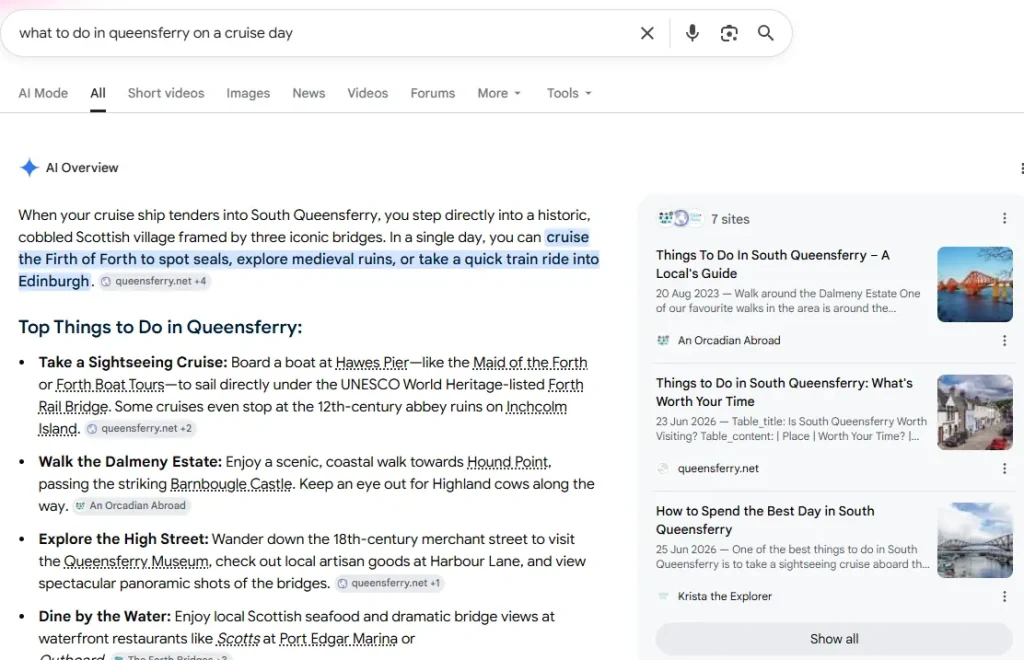
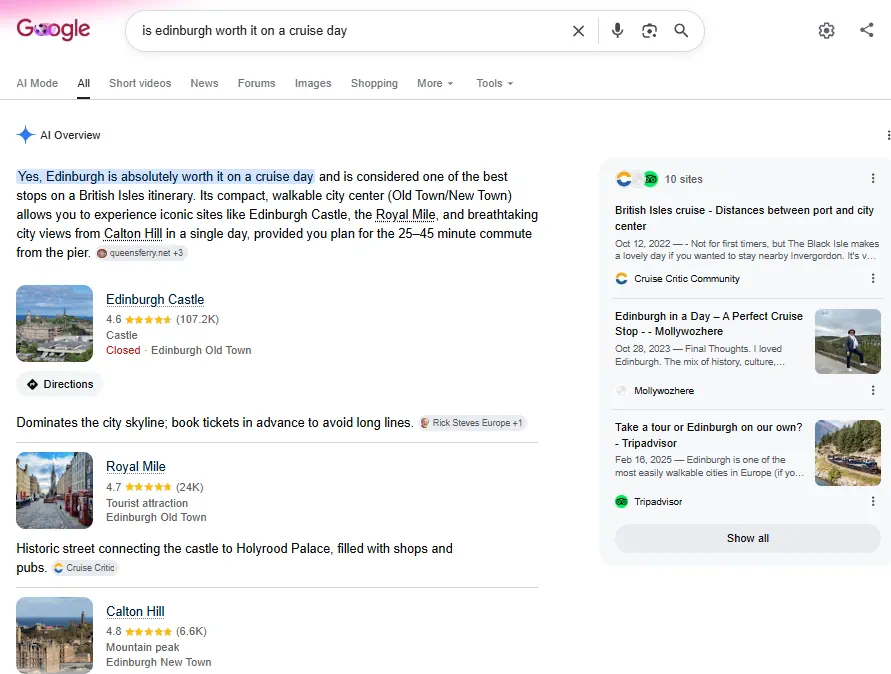
What an AI Citations look like on one of my websites
The risk to the company is down the line. Pew Research Center data says that 60% of Americans read AI-generated summaries at the top of search result pages.
The lesson isn’t that AI-assisted content is the problem. Careless content is the problem, and AI just made careless content cheap enough to publish at a scale nobody bothers to check. Some 44% use ChatGPT to search the web.
How to Audit Your Own Site Before AI Does
Before publishing at scale, run three checks an AI system effectively runs anyway: does this page repeat a template, does every cited fact link to something real, and would a stranger reading five of your pages back to back notice the seams.
Start with the template check. Open your last ten published pages side by side.
If the section order, the example activities, or the closing paragraph are identical bar a location name, that’s the pattern an AI system will spot within seconds of crawling your site.
Next, the citation check. Every stat that isn’t your own first-hand data needs a live link to its actual source — not a name-dropped report with nothing behind it.
- Pull every unlinked statistic across your last ten posts into one list.
- Check whether the same “source” is quoted with different numbers anywhere on the list.
- Fix or remove anything that fails either test before it gets crawled again.
Last, the seams check. Read five recent posts in one sitting, the way a librarian — or an AI system reading your whole domain — actually would.
FAQ
Frequently Asked Questions
What is an AI citation in SEO?
An AI citation is when a system like an AI Overview, ChatGPT, or Perplexity names your page directly as a source inside its answer, rather than listing it as one of several ranked links. It requires the system to trust the content enough to attribute it by name.
Does ranking well still matter if AI citations are the goal?
Yes, but it is no longer sufficient on its own. Ranking gets a page read by the system. Citation is a separate, additional judgement about whether that page is specific and trustworthy enough to be named.
Can publishing more content hurt AI visibility?
Yes, when the content repeats the same structure, examples, and claims across many pages. A system that recognises the template stops trusting any single instance of it, even if each page reads fine in isolation.
Why would a site lose AI citations while still ranking normally?
Ranking and citation are measured differently. A page can hold its organic position while losing the “named source” slot to a competitor whose content reads as more specific or better sourced once the query loses brand context.
Is a full site rebuild ever the wrong move for SEO?
It is the wrong move when it discards content history, blog archives, and crawl signal for a prettier front end with no equivalent SEO plan behind it. Local rankings in particular depend on years of accumulated signal that a rebuild can erase overnight.
Get in touch
Let’s find out where
the leverage is.
Tell me a bit about your site and what you’re trying to fix — I’ll come back with a structural read, not a templated pitch.
Or reach me directly scott@elegantw3.com