


Most guides on how to target content for AI Overviews give you the same list: add FAQ schema, use question-based H2s, answer the query directly.
That advice isn’t wrong — it’s just incomplete. The real issue is that ranking in the top 10 and getting cited in an AI Overview are no longer the same thing, and the gap between them is widening.
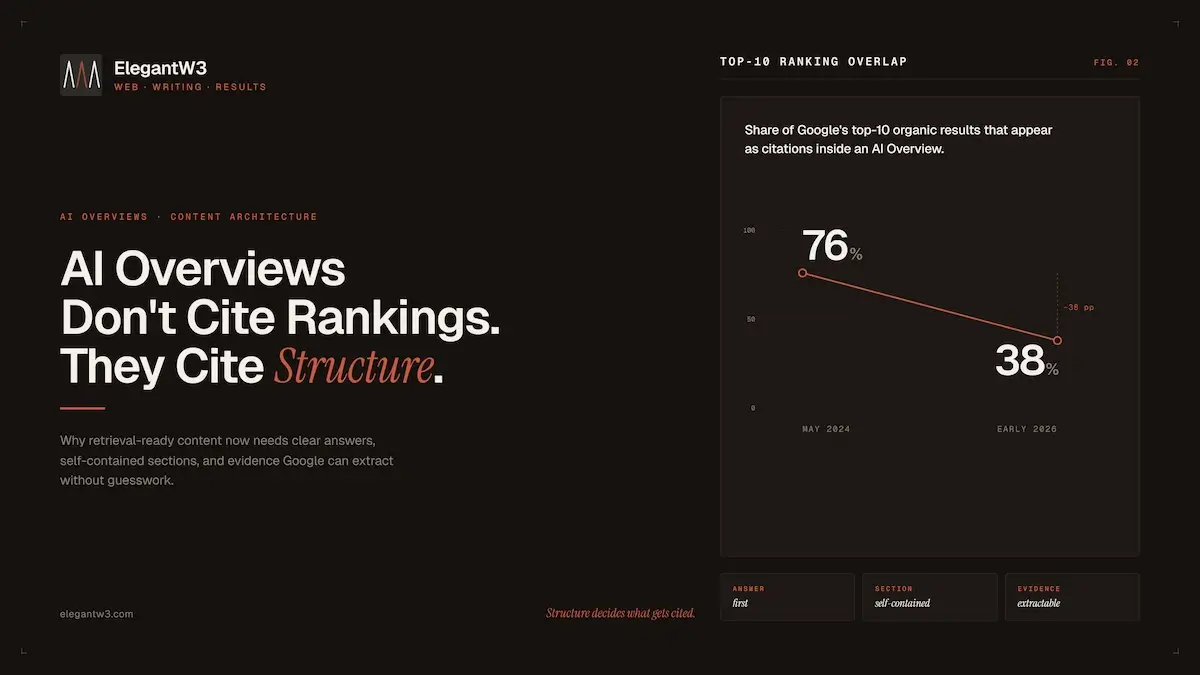
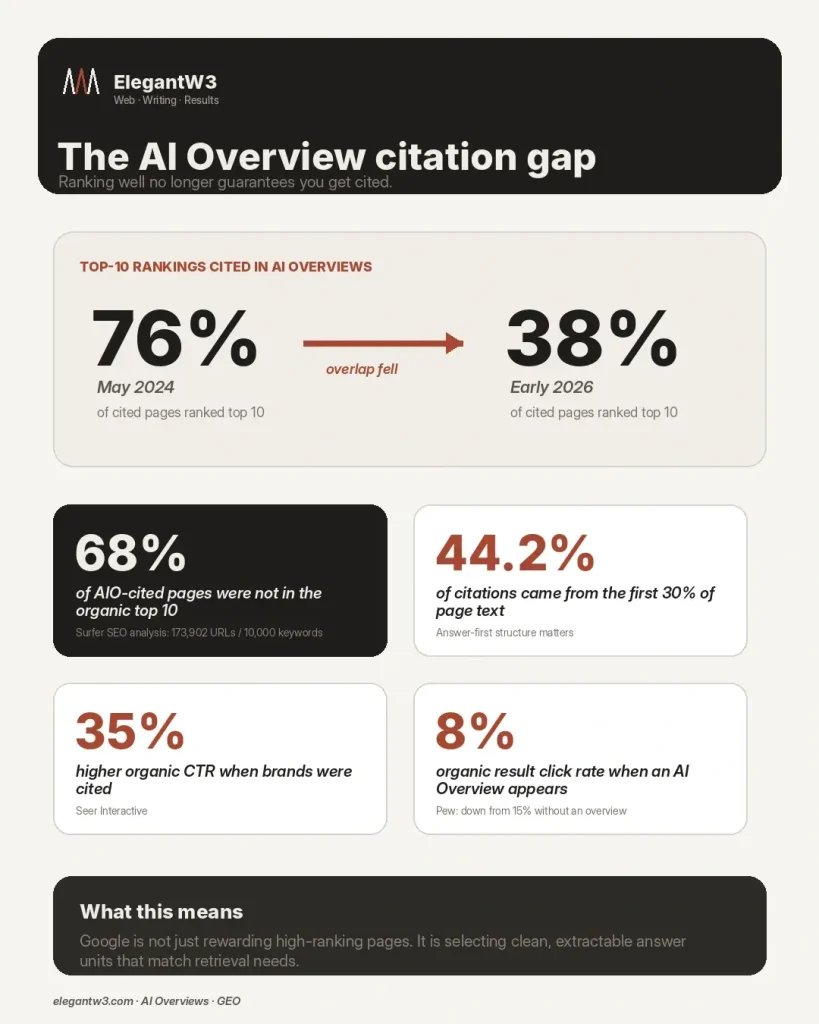
Ahrefs found the overlap between top-10 rankings and AI Overview citations dropped from about 76% in July 2025 to about 38% by early 2026. BrightEdge’s separate analysis put the overlap even lower, at around 17%
Google is actively bypassing higher-ranking pages when it finds content that better serves its retrieval needs. Your ranking doesn’t tell you whether you’ll be cited.
That’s the problem this article addresses.
The Ranking-Citation Gap and Why It Changes Everything
Traditional SEO is a ranking problem. AI Overview citation is a retrieval problem. The two require fundamentally different things from your content.
Ranking rewards domain authority, link equity, and relevance signals built over time. Retrieval rewards something else — a clean, extractable answer that Google’s AI can lift and use without needing the surrounding context to make sense of it. Those aren’t the same standard, and confusing them is why a lot of well-ranked content never appears in an AI Overview.
Surfer SEO’s December 2025 analysis of 173,902 URLs across 10,000 keywords found that 68% of pages cited in AI Overviews weren’t in the organic top 10. They appeared because their content was structured for extraction, not because their domain was strong.
The stakes are real. Seer Interactive’s data shows that brands cited in AI Overviews see 35% higher organic CTR and 91% higher paid CTR compared to when they aren’t cited. Pew Research Center found that users click traditional organic results just 8% of the time when an AI Overview is present — down from 15% when there’s no overview at all.
You can rank second and be invisible. Or you can rank on page two and be the first thing every searcher reads. The variable isn’t your domain. It’s your content architecture.
→ Queensferry.Net is my own site where I used these principles and started to get cited in Google AI Overviews within a couple of months. You’ll see this and more result in my Case Studies.
What AI Overviews Actually Look For
Google’s AI (Gemini) doesn’t read a page the way a human does. It uses query fan-out — a single search query gets decomposed into multiple parallel sub-queries before the Overview is generated. This is why shallow, keyword-matched content consistently loses out to broader, entity-rich content. Your page needs to serve the query cluster, not just the exact phrase someone typed.
The citation data points to a few consistent patterns.
Answer-first content wins. 44.2% of all AI Overview citations come from the first 30% of a page’s text. If your introduction builds context for three paragraphs before getting to the substance, the retrieval system has moved on.
Self-contained sections win. Research points to 134–167 words as the optimal passage length for AI extraction. Each section should be answerable on its own — complete without the reader having read what came before it.
Breadth wins over depth on a single point. Articles cited in AI Overviews cover 62% more facts on average than non-cited articles. That’s not an argument for writing longer — it’s an argument for covering more angles rather than exhausting one.
Worth noting: informational queries still trigger AI Overviews most often, but the split has shifted. Keywords triggering informational overviews dropped from 89% to 57% between October 2024 and October 2025. Commercial intent is increasingly in scope.
The Five Content Failures That Kill Citations
Most content that ranks but doesn’t get cited has one of these structural problems — usually more than one:
- The buried answer. The retrieval system looks for the cleanest, most usable answer on the page. If the intro spends three paragraphs warming up before answering the question, the system moves on. Write the first 100 words as if they’re a standalone answer — because for retrieval purposes, they are.
- Opaque structure. A 3,000-word guide written as one long narrative is hard for AI to parse, even if every sentence is accurate. Each heading section needs to function as a self-contained answer unit, complete without the surrounding context.
- Domain-level authority substituting for content-level authority. This is the one most site owners miss. Strong domain authority doesn’t compensate for a page with no credibility signals. Who wrote it? What data does it cite? Is there anything here that couldn’t have been written by someone who’s never worked in the field? A retrieval system evaluating a single page doesn’t know your domain’s track record. The page has to make the case for itself.
- The wrong query version. A page optimised for “project management software” won’t get cited for “how do I manage a remote team’s workload?” even if they’re commercially adjacent. Intent match matters at the question level, not just the keyword level.
- Targeting queries that don’t trigger AI Overviews. Before optimising, check manually. Transactional, navigational, and branded queries rarely trigger overviews. If most of your traffic is commercial, the absence of AIO citations probably isn’t a content problem.
How to Structure Content for AI Overview Citations
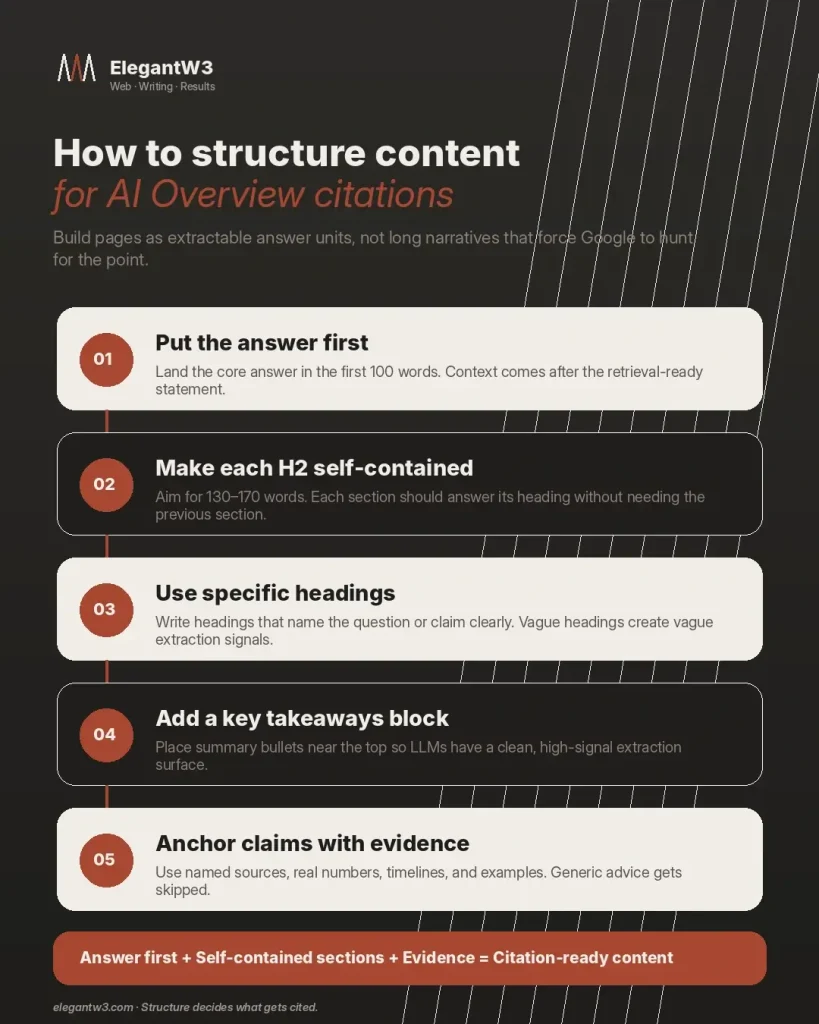
The structural changes aren’t complicated. They run counter to how most long-form content is written, but they’re not mysterious.
Put the answer first. Always. Rewrite introductions so the core answer lands in the first 100 words — context and elaboration follow, they don’t precede. Here’s what the difference looks like:
Before (buried answer): “Internal linking has been a topic of discussion in SEO for many years. There are many schools of thought on the best approach, and it can be difficult to know where to start…”
After (retrieval-ready): “Internal linking is how you tell Google which pages matter. Not through metadata — through the actual structure of what links to what, and how many times. Most sites get this backwards.”
Make each H2 section self-contained. Target 130–170 words per section. The heading should pose a question or make a specific claim; the content beneath it should fully answer or support that heading without requiring the reader to have read the previous section. Think of it as a document within a document.
Use descriptive, specific H2s. “What triggers an AI Overview” outperforms “Let’s look at the mechanism” for retrieval. The heading is what the AI reads first — vague headings produce vague extraction signals.
Add a Key Takeaways section near the top. SE Ranking’s own research confirms their Key Takeaways sections are regularly extracted and cited. LLMs pull from summary blocks with high frequency — put yours where it gets read.
Anchor everything with evidence. Named sites, real numbers, specific timelines. A retrieval system can’t verify your authority, but it can extract and repeat specific, verifiable claims. Generic observations get passed over.
This guide to website architecture and ranking for AI overviews explores the subject in more depth.
Auditing Your Existing Content for Retrieval-Readiness
Most sites have content ranking in the top 10 that isn’t being cited. The audit itself is simple.
Search your target keyword. Check if an AI Overview appears. If one does, look at who’s cited and what their opening paragraph looks like — then compare it to yours. The structural difference is usually obvious within two sentences.
I ran this process with FullTilt Team Development, a client in the coaching and team development space. The site had solid rankings but wasn’t appearing in AI Overviews despite covering the right topics. The fix wasn’t a content rewrite. It was restructuring the intros to lead with the answer, tightening section headings to be more specific, and adding explicit credibility signals — real examples, named methodologies, concrete outcomes from client work. FullTilt’s site now appears as a cited source in Google AI Overviews.
The three-step quick audit:
- Search your target keyword → does an AI Overview appear, and who’s cited?
- Compare your intro paragraph to the cited source’s opening — what’s the structural difference?
- Look at your first H2 section — does it answer its own heading completely in isolation, without context from the rest of the article?
Most of the time the problem isn’t that the content is bad. It’s that the architecture doesn’t give Google a clean extraction surface. Fix the structure first. Everything else follows.
Related reading:
Get in touch
Let’s find out where
the leverage is.
Tell me a bit about your site and what you’re trying to fix — I’ll come back with a structural read, not a templated pitch.
Or reach me directly scott@elegantw3.com