



The short version
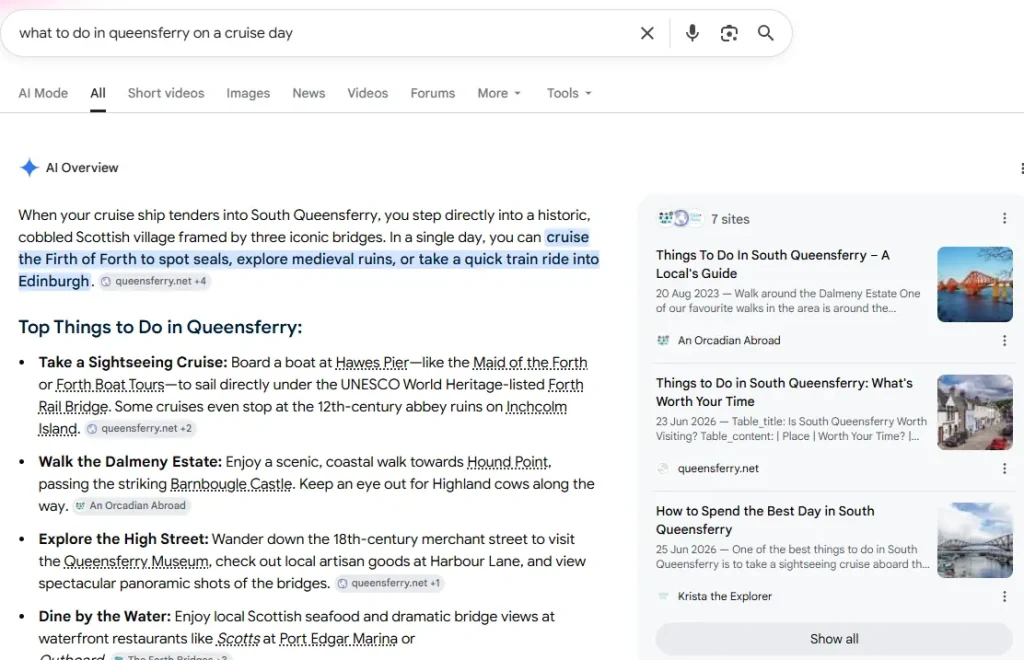
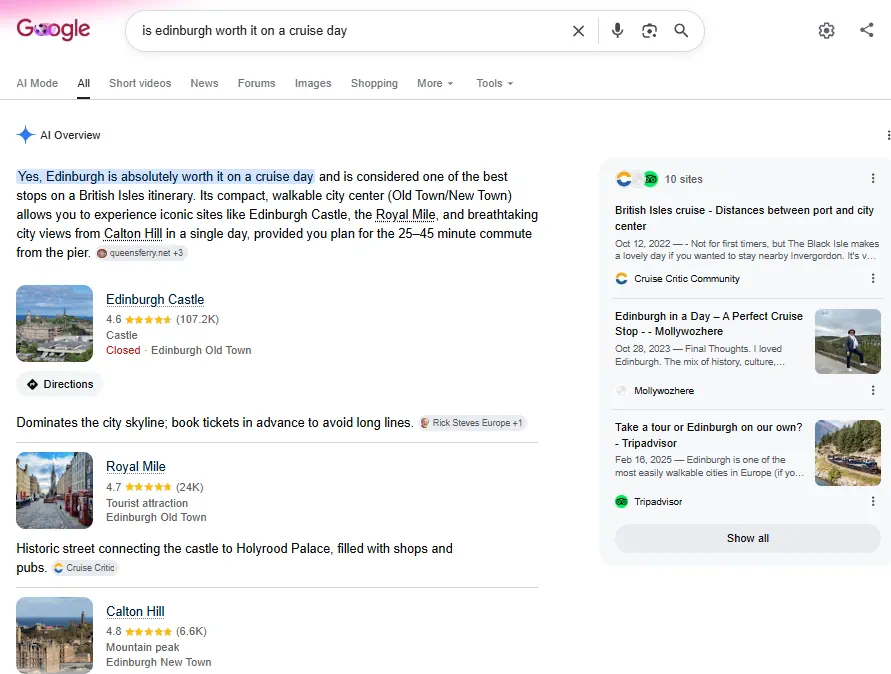
Queensferry.net — my own tourism site — is currently cited as a source inside Google’s AI Overviews for cruise-day queries, verified across two separate anonymous searches. Not ranked top of the results. Quoted inside the AI-generated answer itself, alongside Cruise Critic and TripAdvisor. Screenshots attached below, dated and current.
Context
Queensferry.net is a single-operator site covering South Queensferry and the Firth of Forth. No link-building budget, no in-house dev team, no paid citation-tracking software.
It was built architecture-first: topic hierarchy and page roles mapped before a word of
content was written. GEO wasn’t retrofitted afterward — it was the plan from day one.
The issues
What wasn’t happening before this structure was in place:
- The site ranked for plenty of queries but never appeared inside an AI Overview for them — indexed, not cited.
- Early on, I misread what one of the citation signals meant, and nearly published that misreading as the headline claim.
- No dated, verifiable proof existed anywhere that the structural approach actually produced an AI citation — only the theory.
The approach
What makes a page citable, not just indexed? AI Overviews extract self-contained chunks — a direct answer, a definition — not whole articles. A page can rank well and never get cited if its answer sits three paragraphs into scene-setting. For more information → How to Target Content for AI Overviews.
What five things changed on Queensferry.net? Architecture mapped before content was written. Atomic H2 answers — each heading answers one question directly in 40–60 words, no preamble. FAQ schema on priority pages. Entity markup defining what the site is and who it serves. Internal linking that keeps every cluster page pointing back to its pillar.
What did I get wrong at first? Both citations showed a badge — “+3” on one search, “+4” on the other. I assumed the number meant Google had pulled from that many extra pages on my own domain — proof, I thought, that Queensferry.net was the primary authority.
I tested that across several query variations. It doesn’t hold: the badge appeared even when queensferry.net wasn’t the source shown at all. It counts the rest of the source list generally, not pages from one domain. The smaller claim is the true one, and it’s still a real citation.
The proof
Two verified results, both anonymous searches. “Is Edinburgh worth it on a cruise day?” — searched from a US location — cites queensferry.net alongside Cruise Critic and TripAdvisor, badge reading “+3.” “What to do in Queensferry on a cruise day?” — searched from a UK location — cites queensferry.net again, badge reading “+4.” Both screenshots inserted below, dates visible.
The traffic behind it, from Google Search Console, three months to date: 2,880 clicks,
101,000 impressions, average position 8.5, average CTR 2.9%. The trend line is rising, not flat — clicks and impressions have climbed together since late March, which reads as structure compounding rather than a one-off spike.
Why this matters
A ranking still requires a click. A citation puts your content inside the answer before the searcher clicks anything — trust conferred by Google’s own synthesis, not just a blue link in a list. For a small site with no budget behind it, that’s the difference between competing on domain authority and competing on structure. Structure is the one you can actually build.
AI Overview FAQs
Frequently Asked Questions
What does a “+4 badge” mean in Google AI Overviews?
A “+4 badge” shows the rest of the AI Overview source list beyond the sources already visible. It refers to the total sources behind the answer, not extra pages from one domain.
If the badge appears beside your site, it does not mean Google is citing four more pages from your site. It means there are four additional sources in that AI Overview source set.
How long does it take to get cited in AI Overviews?
Queensferry.net started appearing in AI Overview citations within the first three months of restructuring for GEO. That timeline is useful context, not a universal promise.
How long it takes depends on the site’s existing authority, query competition, page structure, and how cleanly the answer is presented. Anyone quoting a fixed number is guessing.
Do you need a high-authority site to appear in AI Overviews?
No. Queensferry.net is a small, single-operator tourism site with no link-building spend. Its AI Overview citations came from structure, not domain authority.
The work centred on atomic H2 answers, FAQ schema, pillar-cluster architecture, and clean internal linking. Authority helps, of course. But structure gives small sites a route in.
What is an atomic H2 answer?
An atomic H2 answer is a specific heading followed immediately by a direct 40–60 word answer. No warm-up. No throat-clearing. Just the answer under the heading that asks the question.
AI systems can extract these more cleanly because the answer is self-contained, clearly labelled, and separated from the surrounding article noise.
Can any small business site be structured for AI Overview citation?
Yes, if the target queries are informational and the answers can be stated directly. GEO structure is not tied to one industry. It is tied to how clearly the content answers the query.
The best candidates are service, local, travel, comparison, and advice pages where the question has a clean answer and the page can support it with useful context.
Get in touch
Let’s find out where
the leverage is.
Tell me a bit about your site and what you’re trying to fix — I’ll come back with a structural read, not a templated pitch.
Or reach me directly scott@elegantw3.com