

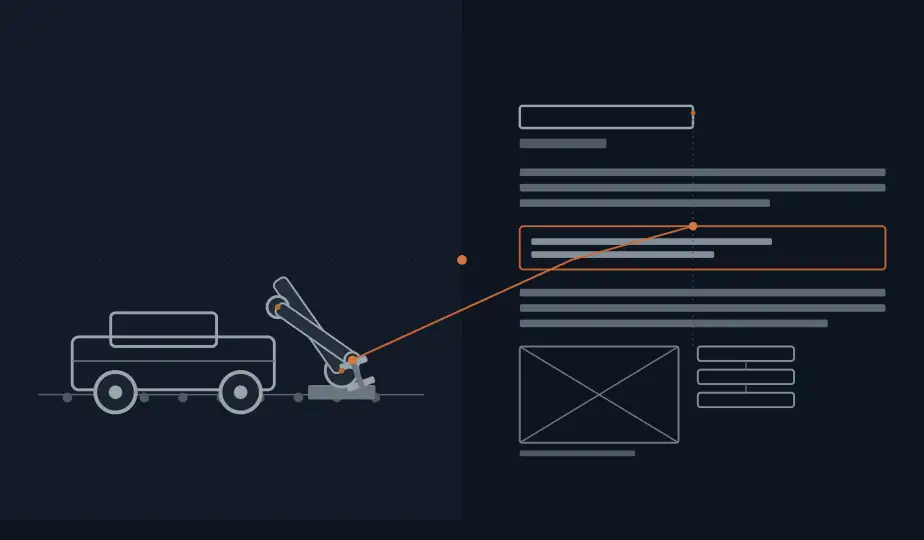

AI will not replace content writers outright. Robots automated car-factory assembly in the 1960s–80s without emptying the workforce — jobs shifted into robotics maintenance and quality control. AI is doing the same to content: absorbing repetitive drafting while strategy and judgment stay human.
A few months ago, the line going round LinkedIn was simple: AI will replace content writers.
Today the same feeds are full of agencies hiring again, freelancers reporting inbound inquiries picking back up, and companies quietly admitting that AI-only content wasn’t the shortcut they’d hoped for.
Nobody’s arguing AI can’t write a sentence. The argument worth having is what happens to the job underneath the sentence — and there’s already a real-world precedent for exactly this question. It’s called the car industry.
In this guide
- No, robots didn’t replace car workers either
- What “replace” actually means vs. what’s happening
- How robots changed the assembly line
- The content writing parallel, role by role
- Who’s actually at risk — and who isn’t
- Why the “jobs are back” signal matters
- What to actually do about it
- Key takeaways
- Frequently asked questions
No — Robots Didn’t Replace Car Workers Either
Every automation panic follows the same shape. New technology arrives, it’s obviously capable of doing part of a job, and the conclusion everyone jumps to is that the whole job disappears.
That’s not what happened when robots hit the assembly line, and it’s not what’s happening to content writing now.
Robots took over welding, painting, and repetitive assembly — the dangerous, monotonous parts of building a car. What they didn’t do was empty the plant.
Headcount shifted. It didn’t vanish. Workers moved into robotics maintenance, quality control, and process design — roles that didn’t exist on the factory floor before the robots showed up.
AI is running the same play on writing. It’s absorbing outlines, first drafts, and basic SEO copy — the repetitive part of the job. Strategy, judgment, and brand voice are still sitting with a person.
What “Replace” Actually Means vs. What’s Actually Happening
“Replace” implies the job vanishes. What’s actually happening is closer to task substitution — one part of the role gets automated, the rest stays exactly where it was.
This distinction gets lost constantly, and it’s worth being precise about it.
AI can write a passable product description in seconds. That’s real. It’s also not the same claim as “AI can run a content strategy,” “AI can interview a client and extract what actually matters,” or “AI can make the editorial call on what to publish and what to kill.”
Those are different jobs stacked inside the same job title. Conflating “AI can write a sentence” with “AI can do the work of a writer” is where most of the fear comes from — and it’s the same conflation people made about robots and factory workers forty years ago.
- Drafting — largely automatable now
- Outlining and research synthesis — partially automatable, still needs a human filter
- Strategy, brand voice, and editorial judgment — not automatable in any way that currently holds up
Source: Google Search Central documentation on AI-generated content and E-E-A-T requirements.
How Robots Changed the Assembly Line
Industrial robots started entering car plants seriously from the 1960s through the 1980s, taking over welding and paint-spraying first — the jobs with the worst injury rates and the least room for skill differentiation.
What the data actually shows
Manufacturing employment peaked at 22% of all US nonfarm jobs in June 1979. By June 2019 it had fallen to 9% — a net loss of 6.7 million manufacturing jobs over forty years, with durable goods (the category that includes auto manufacturing) accounting for 4.3 million of that decline.
Over the same period, total US employment grew by more than 60 million jobs, concentrated in professional and business services, education and health, and leisure and hospitality.
A more recent, sector-specific study backs up the “shifted, not simply vanished” reading directly. A 2024 peer-reviewed study of EU automotive manufacturers from 2002 to 2021 found that robot installations had a positive effect on labour demand in the sector — even as labour productivity per worker fell as robot counts rose, suggesting employment and output grew together rather than machines cleanly swapping in for people.
None of this happened painlessly. Plants closed. Some regions lost jobs faster than new ones opened nearby. The shift was real and it hurt real people in the short term.
“Car worker” as a category didn’t vanish, but it did shrink substantially in the US over the long run — the honest read of the data is contraction plus displacement into other sectors, not a clean one-to-one shift into robotics maintenance roles within the same plants. The more recent EU sector data suggests the relationship is more nuanced still: robot adoption there tracked with rising labour demand, not falling.
The part that keeps getting left out of the AI conversation isn’t that the transition was painless. It’s that automation and employment don’t move in lockstep in the direction most people assume.
The Content Writing Parallel, Role by Role
Line the two industries up side by side and the pattern holds almost exactly.
| Auto industry role | What robots took over | Content writing equivalent | What AI took over | What stays human |
|---|---|---|---|---|
| Assembly line welder | Repetitive welding tasks | Commodity content writer | Basic drafts, product blurbs, templated posts | Editorial judgment on what to publish |
| Paint sprayer | Repetitive, hazardous spraying work | SEO copywriter (basic tier) | First-draft on-page copy, meta variants | Keyword strategy, search intent mapping |
| Line inspector | Nothing — role expanded | Editor / fact-checker | Nothing — role expanded | Accuracy, tone, brand consistency |
| Robotics technician (new role) | N/A — didn’t exist pre-automation | AI-assisted content strategist (new role) | N/A — didn’t exist pre-AI | Directing and auditing AI output at scale |
This is the full 5-column version, styled to match the dark-header/clean-row table already working elsewhere on the site (bold first column, rust-accented last column as the takeaway). If a page genuinely needs 5+ columns, this same pattern — CSS and HTML both scoped to that one module’s custom code panel — is the way to do it, not a new global class.
Read the last row twice. The most interesting jobs in both industries didn’t exist until the automation did.
Nobody was hiring “robotics technicians” in 1955. Nobody was hiring “AI content strategists” in 2019. Both roles are direct products of the technology that was supposed to eliminate the work.
Who’s Actually at Risk — and Who Isn’t
This is where the conversation needs to get specific instead of comforting.
Writers producing pure commodity content — unedited AI drafts sold as finished work, templated listicles, generic product copy — are genuinely losing ground. That part of the market has contracted hard.
Some studies show that freelance writing gigs fell by 20-50% by 2025.
Writers bringing strategy, subject-matter depth, original interviewing, and editorial judgment are seeing the opposite trend. Demand for that end of the market is climbing, not shrinking.
A useful real-world example comes from Firewire Digital’s work with Pinnacle Team Events. The site had been padded with AI-generated blog posts, but organic traffic still fell 35% over ten months.
Firewire removed or consolidated most of that thin content, rebuilt the site around booking-intent pages, and cut the keyword footprint by 78%. The result was not “more content”; it was better-directed content. Top-three rankings rose from 18 to 42, estimated organic traffic increased 49%, and GA4 organic sessions were up 35% year on year.
The takeaway: AI-only content underperforms when it is generic, unedited, thin, and disconnected from search intent. Human-led strategy outperforms because it adds intent selection, pruning, structure, judgement, and real commercial relevance.
Who’s genuinely at risk:
- Writers whose entire output is templated, unedited, or produced without original research
- Anyone selling “AI content at scale” with no editorial layer on top
- Roles defined purely by word-count throughput rather than judgment
Who isn’t:
- Writers who interview real sources and bring information AI can’t access
- Anyone who owns the strategy layer — what to write, why, and for whom
- Editors making the call on accuracy, risk, and brand fit
For more guidance on this, my article on how to write content that targets AI overviews and get cited has some helpful tips.
Why the “Jobs Are Back” Signal Matters
Content writing job postings and freelance inbound inquiries picked back up through late 2025 and into 2026, after an initial AI-driven contraction.
The reason tracks with what happened in manufacturing. Companies discovered that “cheaper” alone doesn’t hold once it starts costing trust, search visibility, or conversion.
Robots made cars cheaper and more consistent, but the market didn’t settle for “cheapest possible car built by the fewest possible people.” It settled for a mix — heavy automation on repetitive tasks, skilled humans on everything that required judgment.
Content is settling into the same equilibrium. The correction isn’t nostalgia for pre-AI writing. It’s the market finding the actual efficient split between what AI does well and what still needs a person.
What to Actually Do About It
This isn’t a full career playbook — that’s a longer piece on its own. I’ve written about this more in my article How to Write Content Worth Citing. But the immediate shift in priorities is straightforward.
Move your value toward the parts of the job AI still handles badly: original interviews, strategic judgment, fact-checking under real stakes, and a point of view nobody else has.
- Stop competing with AI on drafting speed — you’ll lose that race and it’s not the race that matters
- Start treating AI as the thing that removes your busywork, not the thing competing for your job title
- Get specific about the one or two areas where your judgment is genuinely hard to automate, and make that visible in how you position yourself
Key Takeaways
- AI is not replacing content writers wholesale — it’s automating the repetitive part of the job, the same way robots automated repetitive assembly work in car plants
- The job didn’t disappear in manufacturing; it shifted toward new roles built around managing the automation
- Commodity writing is genuinely at risk. Strategic, judgment-heavy writing is seeing rising demand, not falling demand
- The “jobs are back” trend reflects the market correcting toward the actual efficient split between AI and human work, not a rejection of AI
- The move now is repositioning toward the parts of the job AI still can’t do well — not competing with it on speed
FAQ
Frequently Asked Questions
Will AI replace content writers?
Not wholesale. AI is automating the repetitive parts of content writing — first drafts, basic outlines, templated copy — the same way industrial robots automated repetitive car-factory assembly without emptying the workforce.
Is content writing a dying career because of AI?
No, but the commodity end of it is shrinking fast. Writers producing unedited, templated, or purely volume-based content are losing ground, while strategic and subject-matter-expert writing is seeing rising demand.
Did robots actually replace car factory workers, or just change their jobs?
Robots took over repetitive, hazardous tasks like welding and painting, but total plant employment didn’t collapse to zero. Roles shifted toward robotics maintenance, quality control, and process design — jobs that didn’t exist before the robots arrived.
Are companies really hiring content writers again in 2026?
Job postings and freelance inbound inquiries have picked up since late 2025, largely because companies found that AI-only content underperforms on trust, search visibility, and conversion once the novelty of “cheaper and faster” wears off.
What can AI not do that human writers still do?
AI can’t conduct an original interview, make an editorial judgment call under real stakes, or bring a genuinely first-hand point of view. Those functions remain squarely human, regardless of how good AI drafting gets.
Should a business replace its writers with AI?
Only for the commodity layer — templated copy, basic drafts, high-volume low-stakes content. Strategy, brand voice, and fact-checking still need a person in the loop, and cutting that layer tends to show up later as a trust or ranking problem.
Get in touch
Let’s find out where
the leverage is.
Tell me a bit about your site and what you’re trying to fix — I’ll come back with a structural read, not a templated pitch.
Or reach me directly scott@elegantw3.com