


Most zero-click advice stops at the click you lost. Get cited, win the featured snippet, show up in the AI Overview — that’s the whole playbook, everywhere you look.
Nobody’s writing about the click you kept.
That’s the more interesting problem. The visitor who scrolled past the AI Overview and clicked anyway has already told you something: the summary wasn’t enough. They want more. Most pages have no idea what to do with them.
In this guide
- What happens after the AI Overview sends someone to your site
- AI search visitors convert up to 23x higher — if the page earns it
- The cruise passenger theory of AI search
- Backpackers vs. cruise passengers: what the data shows
- Why most landing pages are still built for backpackers
- The excursion desk model
- Five signals that tell a visitor they’re in the right place
- What to cut from a page built for time-boxed visitors
- How to tell if it’s actually converting
- Real example: Queensferry.net’s Shore Day Planner
- Frequently asked questions
What happens after the AI Overview sends someone to your site
When someone clicks through from an AI Overview, they’ve already had their basic question answered. They arrive mid-decision, not mid-search.
They’re hyper-qualified. Time-boxed. Looking for the one thing the summary couldn’t give them — proof, specifics, or a next step.
Most sites still greet them like a first-time browser. A generic hero section. A three-click path to the actual answer. A homepage that assumes they’ve got twenty minutes to explore.
They don’t. The AI already did the exploring for them.
AI search visitors convert up to 23x higher — if the page earns it
Ahrefs found AI-referred visitors convert 23x higher than organic search traffic — 0.5% of their traffic drove 12.1% of signups [Ahrefs study on AI search traffic conversion rates]. That’s not a rounding error. That’s a different category of visitor.
Semrush’s 2026 data shows a more conservative 4.4x average across industries. B2B SaaS companies report lifts of 6x to 27x, depending on how conversion is measured.
| Source | Conversion multiplier | Segment |
|---|---|---|
| Ahrefs | 23× | Company-wide, signups |
| Semrush (2026) | 4.4× | Cross-industry average |
| B2B SaaS reports | 6×–27× | Industry-dependent |
| Ecommerce (Visibility Labs) | 1.31× | ChatGPT referral vs. non-branded organic |
The pattern holds across five independent sources, different methodologies, different industries. AI search sends fewer visitors. Those visitors are worth dramatically more.
But the premium is conditional. It rewards a page built for a pre-qualified visitor. It punishes a page that isn’t.
The cruise passenger theory of AI search
AI Overview visitors behave like cruise passengers, not backpackers.
A backpacker has weeks. No fixed plan. They wander, compare, circle back. Most websites are still built for this person — deep navigation, “learn more” trails, content that assumes patience.
A cruise passenger has four hours ashore. One destination in mind. They need the best possible use of that window, and they need it fast.
AI-referred visitors are cruise passengers. They arrived with an answer already half-formed, looking for exactly one more thing before they act on it.
I run queensferry.net, a Scotland cruise tourism site built entirely around this constraint — visitors with a fixed shore day and no time to waste working it out themselves. The site had to be designed for cruise passengers before I had language for why AI traffic behaves the same way.
Backpackers vs. cruise passengers: what the data shows
An 81,000-site study from Ahrefs found AI-referred visitors view 2.27 pages per session, against 2.79 for search visitors and 2.99 across all traffic [Ahrefs study comparing AI traffic behaviour to search traffic]. Fewer pages. But roughly eight seconds longer spent per page, and a bounce rate 4 to 5 points higher than search traffic.
That’s not disengagement. That’s a cruise passenger who found the one exhibit worth seeing and left satisfied — not a backpacker who got bored halfway round and wandered off.
| Metric | AI-referred visitors | Search visitors |
|---|---|---|
| Pages per session | 2.27 | 2.79 |
| Bounce rate | Higher (+4–5 points) | Baseline |
| Time per page | Longer (~8 seconds more) | Baseline |
Most zero-click content treats a rising bounce rate as a red flag. Here, it’s often the opposite. A visitor who got the answer on one page and left, converted, looks identical in the data to a visitor who left because the page failed them. Bounce rate alone can’t tell those two apart. Conversion rate can.
Why most landing pages are still built for backpackers
Site architecture usually assumes a visitor with time to explore. That assumption is the whole problem.
The patterns show up everywhere once you’re looking for them:
- Navigation buried three levels deep before reaching the actual answer
- Hero sections that introduce the company before addressing the question
- Calls to action stacked below several screens of scrolling
- “Continue reading” patterns that split one answer across multiple pages
Each of these serves someone browsing. Each one actively works against someone who arrived pre-qualified, already sold on the category, looking for confirmation and a fast next step.
The excursion desk model
A good shore excursion desk doesn’t hand passengers a catalogue and wish them luck. It asks one question, gives one clear recommendation, and gets them moving.
Apply the same logic to a page built for AI-referred traffic. Four moves, in order.
State what the page is for, in the first screen. Not the company. Not the category. The specific thing the visitor came to check.
Match the AI summary’s framing in the opening line. If the AI Overview described the answer one way, the page shouldn’t force the visitor to re-orient before it agrees.
Put proof before persuasion. Specifics, numbers, named examples — near the top. Save the story and the softer selling for after the visitor trusts the page is credible.
Remove anything that assumes a second visit. If a section only makes sense to someone who’s already explored three other pages, it doesn’t belong on this one.
None of this is complicated. Most of it is just deleting the parts of a page that were built for a different visitor.
Five signals that tell a visitor they’re in the right place
A cruise passenger at the right excursion desk knows it instantly. A page should do the same.
- The H1 mirrors the question. Same framing the AI Overview used, not a rewritten version of it.
- The answer lands in the first 100 words. No preamble, no scene-setting.
- The subject is named early. Not “our solution” — the actual product, service, or method.
- One strong proof point sits above the fold. A number, a named client, a verified result.
- The next step is unmissable. One action. Not three competing ones.
These five signals also happen to be the same structural markers that make a page more citable by AI Overviews in the first place — the discipline compounds.
What to cut from a page built for time-boxed visitors
Multi-step forms assume patience a cruise passenger doesn’t have. Auto-playing carousels delay the answer they came for. “Meet the team” sections above the fold push the actual content further down the page.
Cut anything that delays the answer or the next step. Move it below the fold, or off the page entirely.
Basic schema markup — FAQPage, HowTo — helps here too, though it’s a supporting tactic rather than the main structural fix.
How to tell if it’s actually converting
Default GA4 setups lump AI referral traffic into “Direct” or generic organic. The segment disappears before you can measure it.
Build a custom channel group filtering referrals from chat.openai.com, perplexity.ai, gemini.google.com, copilot.microsoft.com, and claude.ai. Compare that segment’s conversion rate against standard organic, monthly.
AI referral traffic is still a small share of total traffic industry-wide — roughly 1%, by most current estimates — but it’s compounding fast. The snapshot looks small. The trajectory is the story.
Real example: Queensferry.net’s Shore Day Planner
The Shore Day Planner tool page on my website Queensferry.net was built around exactly this constraint, before the trend had a name.
A cruise passenger has a fixed window ashore. Not a browser with time to explore — someone who needs the best possible use of four hours, decided fast. The tool is the excursion desk model applied literally, not as metaphor. One clear question, one fast recommendation, no detours.
Queensferry.net went from a standing start to over 19,000 monthly impressions in five months, and from 400 to 2,720 monthly clicks over a 90-day window.
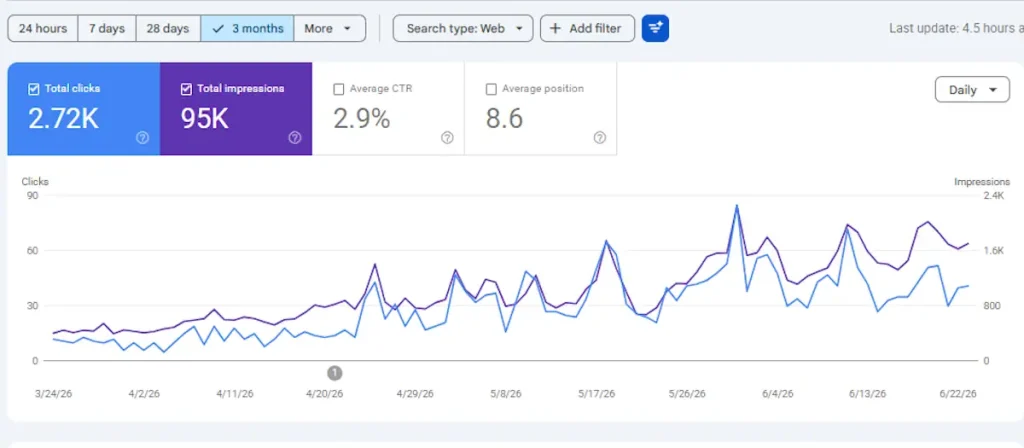
The site’s now cited directly inside a Google AI Overview — for a query the article you’re reading argues most competitors are still getting wrong. The structure that earned the citation is the same structure this article describes.
FAQ
Frequently Asked Questions
What is zero-click search?
A zero-click search is when a user gets a complete answer directly in the search results or an AI Overview, without clicking through to any website.
Why is my click-through rate dropping even though my rankings haven’t moved?
AI Overviews are increasingly answering the query directly in the SERP, so impressions can rise while clicks fall — visibility is up, but fewer of those views convert into a click.
Do AI-referred visitors really convert better than regular search traffic?
Yes, consistently, across independent studies — though the multiplier varies by industry, from roughly 4x to 27x. The mechanism is pre-qualification, not magic: the AI already did the filtering.
Should I redesign my whole site for AI traffic, or just certain pages?
Just certain pages. Prioritise whichever ones are already earning AI Overview citations or showing AI-referral impressions in Search Console — that’s where a redesign pays back fastest.
What if I can’t rebuild a page right now — what’s the smallest useful change?
Rewrite the first 100 words to directly answer the exact question, and cut down to one primary call to action. Both are low-lift and fix the two most common structural mismatches.
Is a high bounce rate from AI traffic actually a bad sign?
Not necessarily. A visitor who gets their answer on one page and leaves, satisfied, can show up identically to a visitor who left because the page failed. Judge by conversion rate, not bounce rate alone.
How is this different from general zero-click SEO advice?
Most zero-click advice focuses on earning the citation — schema, structured answers, visibility metrics. This is about the page the citation sends people to, which almost nobody is writing about.
Get in touch
Let’s find out where
the leverage is.
Tell me a bit about your site and what you’re trying to fix — I’ll come back with a structural read, not a templated pitch.
Or reach me directly scott@elegantw3.com